Mench.ai · Cross-Media Intelligence
Designed for brands · Compatible with existing currency

UCMI: Unified Cross Media Index

A single, 0–100 score that brings together audience reach & frequency with attention, quality of exposure, and interaction. Built to work with existing measurement systems — not replace them.

Cross-media ready GRPs · CTV · digital · social · DOOH · OOH Measurement-friendly panel & census compatible
What UCMI is

One score that keeps current metrics, but makes them comparable

Audience-first · Measurement-friendly

Today, every channel speaks a different language:

  • TV & CTV: Reach, Frequency, GRPs, effective reach
  • Digital: Impressions, viewability, CTR, attention seconds
  • Social & video: engagement, completion rates
  • OOH / DOOH / Print: circulation & modeled reach

UCMI (Unified Cross Media Index) does not ask the market to abandon these metrics. Instead, it normalizes and unifies them into a single, 0–100 impact score that brands can use to compare campaigns, formats, and channels on equal footing.

UCMI is designed so that existing reach & frequency frameworks, GRP curves, and panel-based measurement remain the foundation. UCMI simply adds high-resolution quality signals on top and compresses everything into one interpretable score.

How it works

Two layers, five components, one unified index

Transparent · Auditable · Configurable

Layer A – Contact Quality (Census-based)

The first layer captures how strong each contact opportunity was, using site-level and platform-level delivery data (census logs). Four components are measured vs configurable targets, each normalized to a 0–1 score and clipped at 1:

  • Quality of Exposure: a unified visibility score from digital viewability, Nielsen-style visibility metrics, and Geopath / OOH visibility modeling
  • CTR quality: click-through rate vs benchmark (e.g. 1%)
  • Attention time quality: average view time vs attention target (e.g. 10s)
  • Interaction quality: scan / interaction rate vs target (e.g. 30% of impressions exposing a scannable unit)

Combined, these form a UCMI Core contact quality score in the range 0–1, capturing how well each impression performed as a communication opportunity.

Layer B – Audience Structure Index (Reach & Frequency)

The second layer is built directly on top of unique viewer reach and frequency distributions, in the same spirit as GRPs and effective reach modeling.

For each placement or campaign, we calculate:

  • Reach%: % of the target universe reached at least once
  • Effective Reach% (3+): % of the universe at three or more exposures
  • Average frequency: total impressions ÷ unique viewers, with an “ideal window” (e.g. 3–7)
  • Over-exposure share: share of impressions delivered at heavy frequencies (e.g. 10+), interpreted as potential waste

Each of these is normalized into a 0–1 score against configurable benchmarks, and combined into a single Audience Structure Index (ASI) in the range 0–1.

ASI = Reach, Effective Reach, Frequency, Waste Compatible with panel-based R&F systems

Any organization already modeling reach, frequency, and GRPs can use the same concepts to understand ASI. No new math is required — UCMI simply packages it as a transparent index and links it to digital quality.

Final UCMI – Putting it together

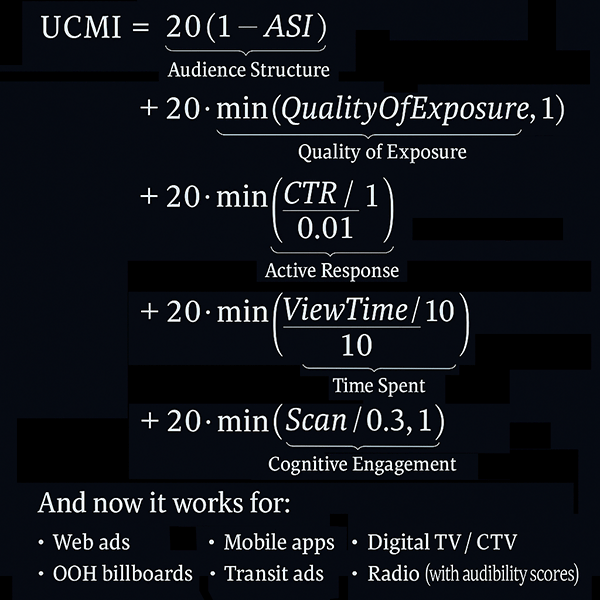
The canonical “per-contact” expression of UCMI weights the five components equally (each worth up to 20 points, summing to 100):

UCMI = 20·(1 − ASI)
    + 20·min(QualityOfExposure, 1)   
    + 20·min(CTR / 0.01, 1)       
    + 20·min(ViewTime / 10, 1)
    + 20·min(Scan / 0.3, 1)       

In practice, implementations can also use a weighted average of 0–1 scores:

UCMI = 100 × ( w₁·QualityOfExposureScore
        + w₂·CTRScore
        + w₃·AttentionTimeScore
        + w₄·InteractionScore
        + w₅·AudienceStructureIndex )

where w₁ + w₂ + w₃ + w₄ + w₅ = 1

Weights can be tuned by brand, category, or campaign objective, while the underlying computation remains simple, auditable, and aligned with existing measurement practices.

Key point: UCMI does not invent a new currency. It expresses existing currencies together — reach / frequency, Quality of Exposure, attention, and interaction — on a single, intuitive 0–100 scale.

Quality of Exposure

How online viewability and offline visibility become one metric

Digital · TV · OOH · Print · Audio

Why “Quality of Exposure” matters

The core question behind any media impression is simple: did people actually have a meaningful chance to see or hear the ad? UCMI captures this through a normalized metric we call QualityOfExposure, which replaces raw “viewability” and allows online and offline media to be compared consistently.

Without this layer, cross-media comparisons over-reward channels with response data and under-value high-impact exposures that may not produce a click but still build memory and intent.

Digital: pixel-based viewability

For digital display, video, and in-app inventory, QualityOfExposure is based on standard viewability definitions (MRC, IAB, or brand-specific):

  • Share of measurable impressions that were viewable
  • Optionally upgraded with attention seconds (e.g. LIQWID / RealVu style view-time measurement)

These raw values are then normalized against a target, for example:

ViewabilityPct = ViewableImpressions / MeasurableImpressions
QualityOfExposureDigital = min( ViewabilityPct / TargetViewability , 1 )

A campaign that hits or exceeds its viewability / attention target scores 1.0 on this component; under-delivery scales proportionally toward 0.

Offline & cross-screen: Nielsen-style proxies & Geopath

Offline channels do not have pixels, but they do have mature visibility models. UCMI treats these as equivalent “viewability-like” inputs and normalizes them onto the same 0–1 scale:

  • TV / CTV: attention scores, presence detection, second-by-second retention and co-viewing signals
  • OOH / DOOH: Geopath visibility models (e.g. Visibility Adjustment Index, dwell time, viewing angle, illumination)
  • Print: probability that an ad was seen on a given page or position (readership, section affinity, repeated openings)
  • Audio / Radio / Streaming: audibility and in-room presence scores, panel-based listening metrics

Each of these sources already produces a score that effectively answers: how likely was this placement to be noticed?

NormalizedVisibility = RawVisibilityMetric / TargetVisibilityMetric
QualityOfExposureOffline = min( NormalizedVisibility , 1 )

One cross-media QualityOfExposure metric

For any channel, we simply choose the appropriate input and apply the same clipping rule:

QualityOfExposure = min( NormalizedVisibility , 1 )

Where the channel-specific NormalizedVisibility is:

  • Digital: Viewability% (and/or attention seconds) ÷ target
  • OOH / DOOH: Geopath VAI or similar ÷ target
  • TV / CTV: attention or presence score ÷ target
  • Print: modeled ad-exposure probability ÷ target
  • Audio: audibility / listening score ÷ target

Result: a billboard with strong Geopath visibility, a high-attention CTV spot, and a fully viewable digital display impression can all earn the same QualityOfExposure score when they clear their respective visibility benchmarks. Different channels, one metric.

In the UCMI expression 20·min(QualityOfExposure, 1), this component is worth up to 20 points, regardless of channel — making quality of exposure truly comparable across Web, mobile apps, OOH billboards, transit media, print, digital TV / CTV, and radio with audibility scores.

For brands & buyers

What UCMI enables in practice

Planning · Optimization · Proof

1. Cross-media comparability

Compare CTV vs digital vs social vs DOOH using the same scale: which tactic delivers the highest UCMI per dollar?

  • Evaluate premium formats vs standard display
  • Justify CTV or high-impact units with one unified story
  • Communicate results in a language the entire organization can follow

2. Budget optimization & MMM/MTA

Because UCMI is numeric and decomposable, it can feed directly into MMM or attribution models as a quality-adjusted GRP-like input.

  • Shift spend toward surfaces with higher UCMI per dollar
  • Model scenarios before committing budget
  • Connect attention and interaction back to sales outcomes

3. Proof of premium inventory

Publishers and platforms can show that premium formats not only deliver more attention, but do so with better reach & frequency structure:

  • Higher contact quality (QualityOfExposure, view-time, interactions)
  • Cleaner audience structure (good reach, controlled waste)
  • Stronger UCMI vs commodity placements

4. Measurement-ecosystem alignment

Because ASI is built from the same ideas as GRPs and effective reach, UCMI fits naturally alongside existing industry standards and panel-based systems. It can be:

  • Adopted without discarding current currencies
  • Used jointly with existing audience-measurement providers
  • Integrated as a quality layer on top of reach / frequency
Executive snapshot

In one sentence

UCMI is a unified cross-media impact score that keeps traditional reach & frequency logic intact and enriches it with Quality of Exposure, attention, and interaction — so brands, publishers, and measurement providers can all speak in one number instead of ten.

Where UCMI gets its data

  • Audience structure (ASI): unique viewer logs and/or panel-based reach & frequency estimates plus a defined universe size.
  • Contact quality: measurable impressions, visibility / viewability metrics, clicks, view-time / attention seconds, and scan / interaction events.
  • Offline visibility: TV/CTV attention scores, Geopath OOH visibility indices, print exposure probabilities, audio audibility metrics.

Why it’s “measurement-friendly”

  • Uses familiar constructs: reach, effective reach, average frequency, GRP-style thinking
  • All components are explicit, numeric, and adjustable
  • Compatible with both sample-based and census-based data flows
  • Can be implemented as a reporting layer on top of existing systems

How to use this page

This document can be shared with:

  • Brands & agencies – a simple explanation of what UCMI is and how it helps planning and optimization
  • Publishers & platforms – a framework to quantify the value of premium inventory
  • Measurement & data partners – a technical-friendly overview of how UCMI complements existing reach / frequency measurement
Technical appendix

UCMI & Audience Structure Index – Formal definition

For product, data science & measurement teams

This section documents the core inputs and normalization steps used to compute the Audience Structure Index (ASI), QualityOfExposure, and the final UCMI value. The goal is to make the system transparent and easy to integrate into existing analytics and measurement pipelines.

1. Inputs

Per placement or campaign, over a defined time period:

  • Census or calibrated logs (digital, CTV, DOOH): unique viewer identifiers, impression counts, clicks, view-time / attention seconds, scan / interaction events.
  • Universe definition: target population size, from a panel or measurement partner.
  • Visibility metrics: digital viewability, TV/CTV attention scores, Geopath indices, print exposure probabilities, audio audibility, each with channel-specific targets.

2. Audience Structure Index (ASI)

ASI is composed of four normalized components — ReachScore, EffReachScore, FreqScore, and WastePenaltyScore — each in the range 0–1. Example definitions:

ReachPct = unique_viewers / universe × 100
EffReachPct = viewers_with_3plus_exposures / universe × 100
AvgFreq = total_impressions / unique_viewers
OverexposureShare = impressions_at_10plus / total_impressions

Each metric is divided by a configurable target and clipped at 1. ASI combines them with transparent weights (example):

ASI = 0.30·ReachScore + 0.30·EffReachScore + 0.20·FreqScore + 0.20·WastePenaltyScore

3. QualityOfExposure and other contact-quality metrics

For each channel, we derive a visibility-like metric, normalize it against a target, and clip at 1.0:

NormalizedVisibility = RawVisibilityMetric / TargetVisibilityMetric
QualityOfExposure = min( NormalizedVisibility , 1 )

CTR, attention time, and interaction metrics follow the same pattern:

MetricScore = min( ActualMetric / TargetMetric , 1 )

4. Final UCMI calculation

With all five components on a 0–1 scale, the canonical UCMI formula with equal weights is:

UCMI = 20·(1 − ASI)
    + 20·min(QualityOfExposure, 1)
    + 20·min(CTR / 0.01, 1)
    + 20·min(ViewTime / 10, 1)
    + 20·min(Scan / 0.3, 1)

Or, more generally, as a weighted sum of normalized scores scaled to 0–100 (see main section above). Different stakeholders can choose different weightings while keeping the underlying definitions stable.

5. Ecosystem alignment

Because ASI is derived from standard reach / frequency concepts and QualityOfExposure is built on top of existing viewability / visibility metrics, UCMI can be:

  • Implemented as a reporting or planning layer on top of existing systems
  • Used as a quality-adjusted GRP-like input into MMM / MTA models
  • Provided alongside existing currencies to enhance — not replace — them

The result is a single, transparent index that expresses both who was reached and how well the communication landed using the same building blocks the industry already understands.